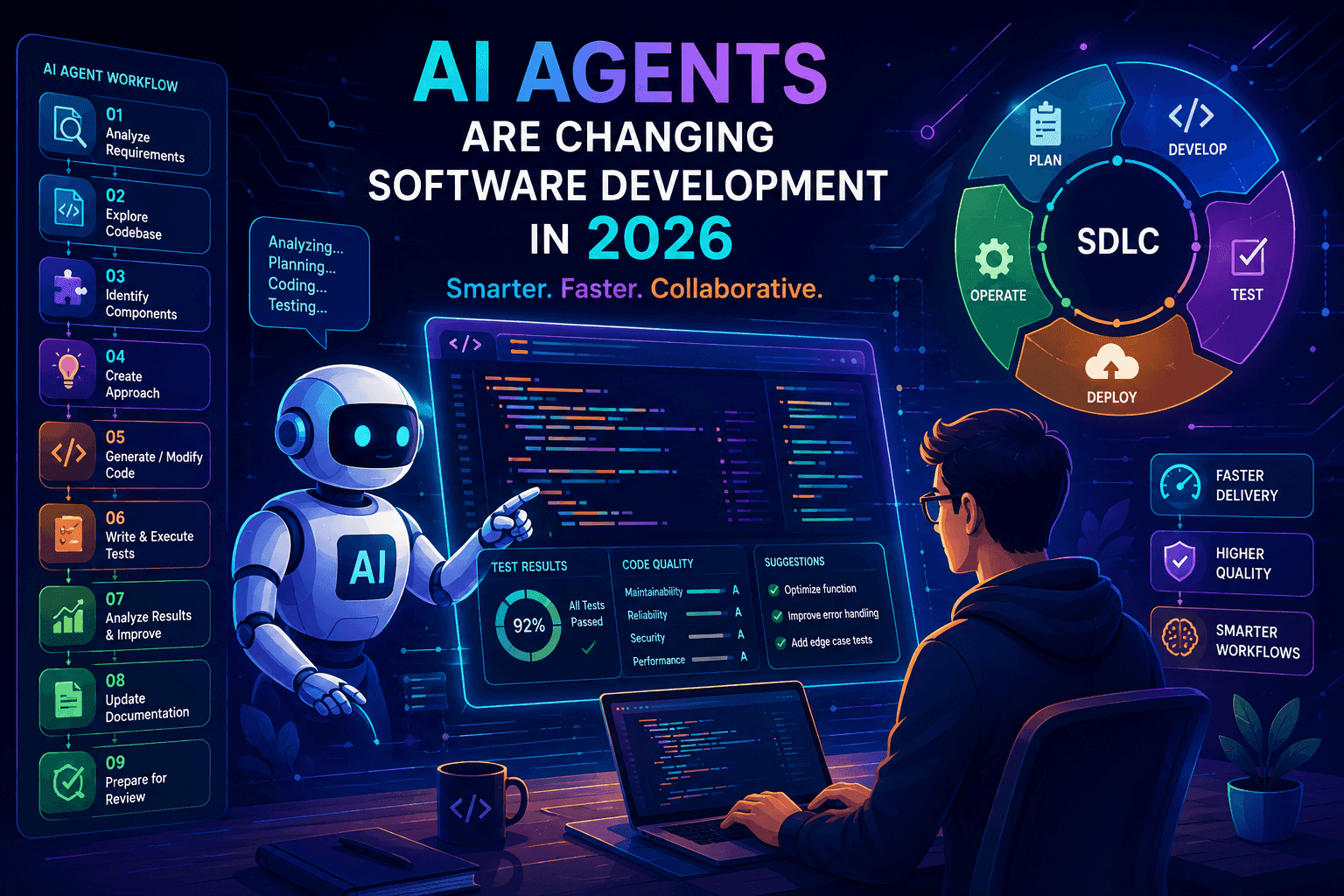
AI Agents Are Changing Software Development in 2026
Artificial Intelligence has already changed the way developers write code, but the next stage goes far beyond code suggestions. AI agents are becoming active participants in the software development lifecycle, helping teams understand requirements, analyze existing applications, generate code, execute tests, investigate issues, and prepare documentation.
The shift from AI assistants to AI agents represents an important change in modern software engineering.
From AI Assistants to AI Agents
Traditional AI coding assistants mainly help developers complete code, generate functions, explain existing logic, or identify potential errors.
AI agents take this concept further.
Instead of responding only to individual prompts, an AI agent can be given a broader objective such as implementing a feature, investigating a defect, improving test coverage, or analyzing an application.
The agent can then break that objective into smaller tasks and work through them systematically.
For example, an AI development agent may:
- Analyze a requirement
- Explore an existing codebase
- Identify affected components
- Create an implementation approach
- Generate or modify code
- Write unit tests
- Execute tests
- Analyze failures
- Update documentation
- Prepare changes for developer review
This creates a collaborative development model where engineers define the direction while AI assists with execution.
Faster Development Without Compromising Engineering
One of the biggest advantages of AI-assisted development is speed.
Developers traditionally spend significant time understanding unfamiliar code, searching documentation, creating repetitive components, debugging errors, and writing tests.
AI agents can reduce the time spent on many of these activities.
However, faster code generation should not mean bypassing engineering practices.
AI-generated changes should still pass through established processes such as code reviews, automated testing, security scanning, quality checks, and deployment approvals.
The goal is not simply to generate more code. It is to help engineering teams deliver reliable software more efficiently.
AI Across the Development Lifecycle
AI is increasingly being applied throughout the Software Development Life Cycle (SDLC).
During planning, AI can help analyze requirements and identify missing scenarios.
During development, it can generate code, suggest improvements, explain complex modules, and assist with refactoring.
During testing, AI can generate test cases, identify edge cases, and help investigate failures.
During operations, AI can analyze logs, detect unusual behavior, summarize incidents, and assist teams during troubleshooting.
This means AI is gradually becoming part of the entire engineering workflow rather than being limited to the developer's code editor.
Developers Remain at the Center
The rise of AI agents does not remove the importance of software engineers.
Architecture decisions, business understanding, security considerations, performance trade-offs, and accountability still require strong engineering judgment.
AI can propose a solution, but developers must determine whether that solution is appropriate for the application.
The most effective engineering teams will therefore treat AI as a development partner rather than an autonomous replacement for engineering expertise.
Building an AI-Ready Engineering Culture
Organizations adopting AI development tools should establish clear guidelines.
Teams need to define where AI-generated code is acceptable, how it should be reviewed, what information can be shared with AI systems, and which security controls must remain mandatory.
Developers should also learn how to provide clear context and evaluate AI-generated solutions critically.
AI literacy is quickly becoming another important engineering skill alongside programming, architecture, testing, cloud, and DevOps.
Conclusion
AI agents represent the next stage of AI-assisted software development.
They can help development teams move faster by supporting requirements analysis, coding, testing, debugging, and documentation. But their greatest value comes when they operate within strong engineering practices.
The future of software development is unlikely to be developers versus AI. It will increasingly be developers working with AI to build better software faster, while humans remain responsible for the decisions that matter most.