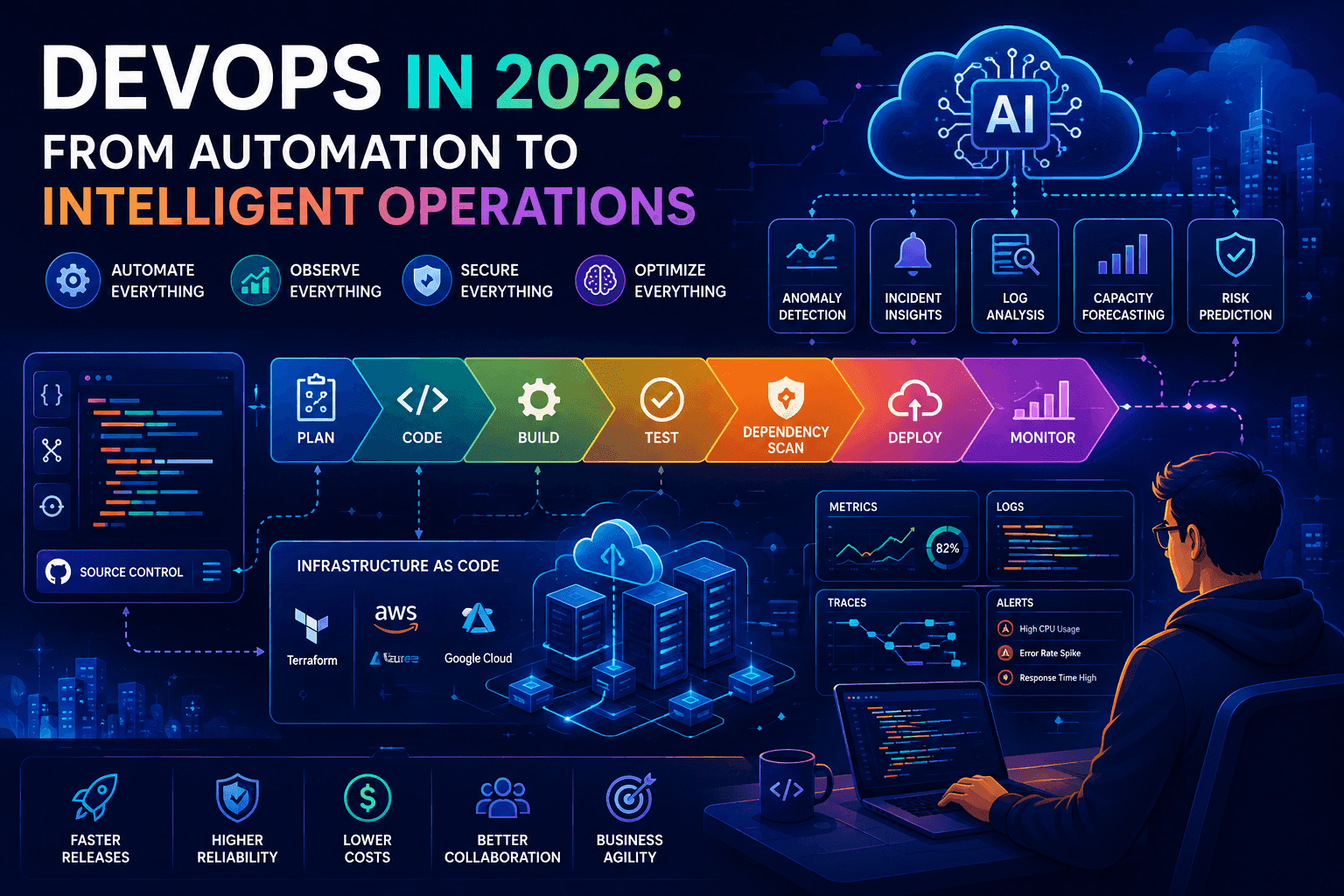
DevOps in 2026: From Automation to Intelligent Operations
DevOps transformed software delivery by bringing development and operations teams closer together and automating the path from code to production.
Today, DevOps is entering another stage of evolution. Cloud-native platforms, Infrastructure as Code, observability, platform engineering, security automation, and Artificial Intelligence are creating increasingly intelligent software delivery environments.
The focus is shifting from simply automating operations to making operations smarter.
CI/CD Is Only the Beginning
Continuous Integration (CI) and Continuous Delivery (CD) remain fundamental DevOps practices.
Modern pipelines automatically build applications, execute tests, perform quality checks, scan for vulnerabilities, create deployment artifacts, and deploy applications across environments.
But organizations are now looking beyond basic pipeline automation.
Modern DevOps platforms increasingly connect the entire engineering lifecycle — from source code and infrastructure to security, monitoring, incidents, and application performance.
The result is greater visibility, faster feedback, and more reliable software delivery.
Infrastructure as Code
Cloud infrastructure has become too complex to manage reliably through manual configuration alone.
Infrastructure as Code (IaC) allows teams to define servers, networks, databases, permissions, and other infrastructure components through version-controlled configuration.
This provides several advantages:
- Repeatable environments
- Consistent infrastructure configuration
- Easier disaster recovery
- Better change tracking
- Automated environment creation
- Reduced manual configuration errors
Infrastructure changes can therefore follow many of the same review, testing, and deployment practices used for application code.
AI Enters DevOps
Artificial Intelligence is also becoming increasingly useful in operations.
Modern environments generate enormous amounts of information through application logs, infrastructure metrics, traces, deployment events, security alerts, and user activity.
AI-assisted systems can help teams analyze this information and identify patterns that would otherwise take considerable time to investigate.
AI can assist with areas such as:
- Anomaly detection
- Incident summarization
- Log analysis
- Root-cause investigation
- Capacity forecasting
- Deployment risk assessment
This does not eliminate operations teams. Instead, it gives them better tools for understanding and managing increasingly complex environments.
Observability Becomes Essential
Traditional monitoring usually answers a straightforward question:
Is the system working?
Observability goes further by helping engineers understand why a system is behaving in a particular way.
Modern observability commonly combines:
- Metrics
- Logs
- Distributed traces
- Application performance information
- Infrastructure events
When these signals are connected, engineers can follow requests across services and identify where failures, bottlenecks, or performance problems originate.
This becomes particularly important for distributed and microservices-based applications.
Security Moves Into the Pipeline
Security can no longer be treated only as a final check before production.
DevSecOps integrates security controls throughout the development and delivery process.
Automated pipelines can perform:
- Dependency scanning
- Static code analysis
- Container scanning
- Secret detection
- Configuration validation
- Automated security checks
Finding vulnerabilities earlier generally makes them easier, faster, and less expensive to resolve.
The Rise of Platform Engineering
As DevOps environments grow, developers can become overwhelmed by infrastructure, deployment, security, and cloud configuration.
Platform engineering addresses this by creating reusable internal platforms and standardized workflows.
Instead of every development team independently configuring infrastructure, pipelines, monitoring, and deployments, platform teams provide approved building blocks and self-service workflows.
This allows developers to focus more heavily on building business functionality while maintaining organizational engineering, security, and operational standards.
Moving Toward Intelligent Operations
The next evolution of DevOps brings these capabilities together.
Automation handles repetitive work. Observability provides visibility. AI assists with analysis. DevSecOps strengthens security. Platform engineering simplifies developer workflows.
Together, these practices enable organizations to build software delivery environments that are increasingly automated, observable, secure, scalable, and intelligent.
Conclusion
DevOps in 2026 is no longer defined by CI/CD alone.
Infrastructure as Code, cloud-native platforms, observability, DevSecOps, platform engineering, and AI-assisted operations are creating a more intelligent approach to software delivery.
Organizations that combine automation with strong engineering standards and operational visibility can achieve faster releases, greater reliability, stronger security, and improved business agility.